NMN Stability in Supplements: ICH-Aligned Testing Protocol and Formulation Best Practices
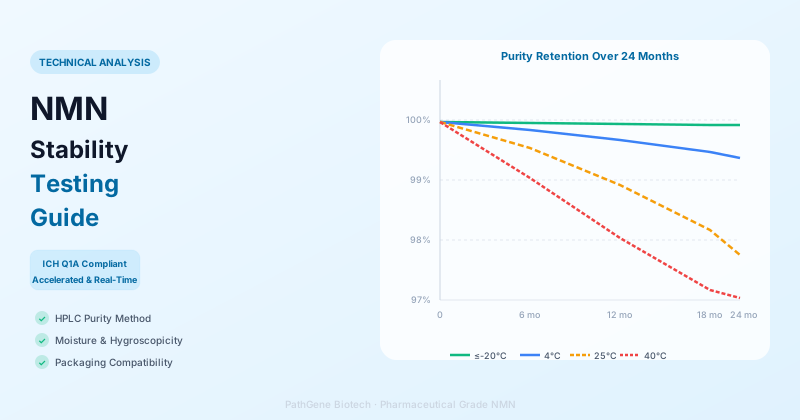
Why NMN Stability Is a Critical Formulation Concern
NMN (β-Nicotinamide Mononucleotide) is hygroscopic, thermolabile, and photosensitive. These properties make bulk ingredient stability testing — and formulation stability testing — essential steps before launch. Formulators who skip these steps risk launching products that lose significant potency before their stated shelf life, or fail regulatory stability testing post-launch.
Degradation Pathways
NMN degrades primarily through:
- Hydrolysis: NMN can hydrolyze to nicotinamide mononucleotide base components under aqueous conditions, especially above pH 6. This is the primary degradation route in liquid formulations.
- Oxidation: The nicotinamide ring is susceptible to oxidative degradation, producing nicotinamide N-oxide and related impurities.
- Epimerization: Under acidic conditions (pH < 4), the ribose portion can epimerize, reducing the proportion of the β-isomer. This is rarely seen at typical supplement conditions.
- Moisture-induced condensation: In powder forms, high moisture promotes degradation via Maillard-like reactions with reducing sugars if present.
ICH-Aligned Stability Testing Protocol
Following ICH Q1A(R2) guidelines, a standard stability protocol for NMN bulk ingredient should include:
| Storage Condition | Temperature/RH | Purpose | Sampling Points |
|---|---|---|---|
| Long-term | 25°C / 60% RH | Primary shelf life determination | 0, 3, 6, 9, 12, 18, 24 months |
| Intermediate | 30°C / 65% RH | Relevant for tropical climates | 0, 3, 6, 12 months |
| Accelerated | 40°C / 75% RH | Early failure prediction (6 months) | 0, 1, 2, 3, 6 months |
| Stressed | 60°C / open dish | Identify degradation products | 1, 2, 4 weeks |
Key Analytical Tests at Each Timepoint
- Assay (HPLC): Primary purity, target ≥98.0% throughout shelf life. Flag any decrease > 1% from initial.
- Water content (Karl Fischer): Must remain ≤ 1.5% (pharmaceutical grade). Spike in moisture often precedes potency loss.
- Specific rotation: Monitor for epimerization. Alert if [α]D²⁵ falls below +38°.
- Impurity profile (HPLC): Track individual impurities — any single impurity exceeding 0.15% (ICH Q3B threshold for new degradants) requires identification.
- Appearance: Color change from white to yellow indicates oxidative degradation. Caking indicates moisture ingress.
- pH (for liquid forms): Maintain between 4.5–6.0 to minimize hydrolysis.
Formulation-Specific Stability Considerations
Capsule: Most stable format for NMN. Use HDPE bottles with desiccant (2g silica per 60-count bottle) or blister packs with aluminum foil backing. Avoid clear PET containers — UV exposure accelerates degradation.
Tablet: NMN is compatible with common tableting excipients (MCC, HPMC, stearic acid). Avoid calcium phosphate dibasic — its alkaline pH promotes hydrolysis. Film coating with HPMC provides a moisture barrier.
Powder sachet: High surface area increases exposure. Use triple-layer aluminum foil sachets (PET/AL/PE). Nitrogen flush before sealing. Shelf life typically 12–18 months vs. 24 months for capsules.
Liquid (beverage or IV): Most challenging. Buffer to pH 4.5–5.0 (citrate or acetate buffer). Sterilize by sterile filtration (0.22 μm) not terminal heat. Nitrogen headspace essential. Consider lyophilized powder for injection (pharma-grade applications).
Packaging Recommendations
- Bulk storage: double HDPE liner, foil-laminated aluminum drums, nitrogen purge, silica desiccant.
- Consumer packaging: HDPE or glass amber bottle, induction seal, oxygen absorber.
- Transport: avoid direct sunlight; cold chain (2–8°C) for pharmaceutical grade; ambient with desiccant for supplement grade.
PathGene Stability Documentation
PathGene NMN has passed 24-month real-time stability testing (25°C/60% RH) with assay ≥99.0% at all timepoints. Full stability study data available upon request under NDA. Request NMN stability data package.
Ready to evaluate our products?
Request a sample or send an inquiry — our R&D team responds within 24 hours.
